
What We Heard in Exeter: Health Care After a Hospital Affiliation
And as New Hampshire looks ahead, those issues are only becoming more acute for health care consumers.
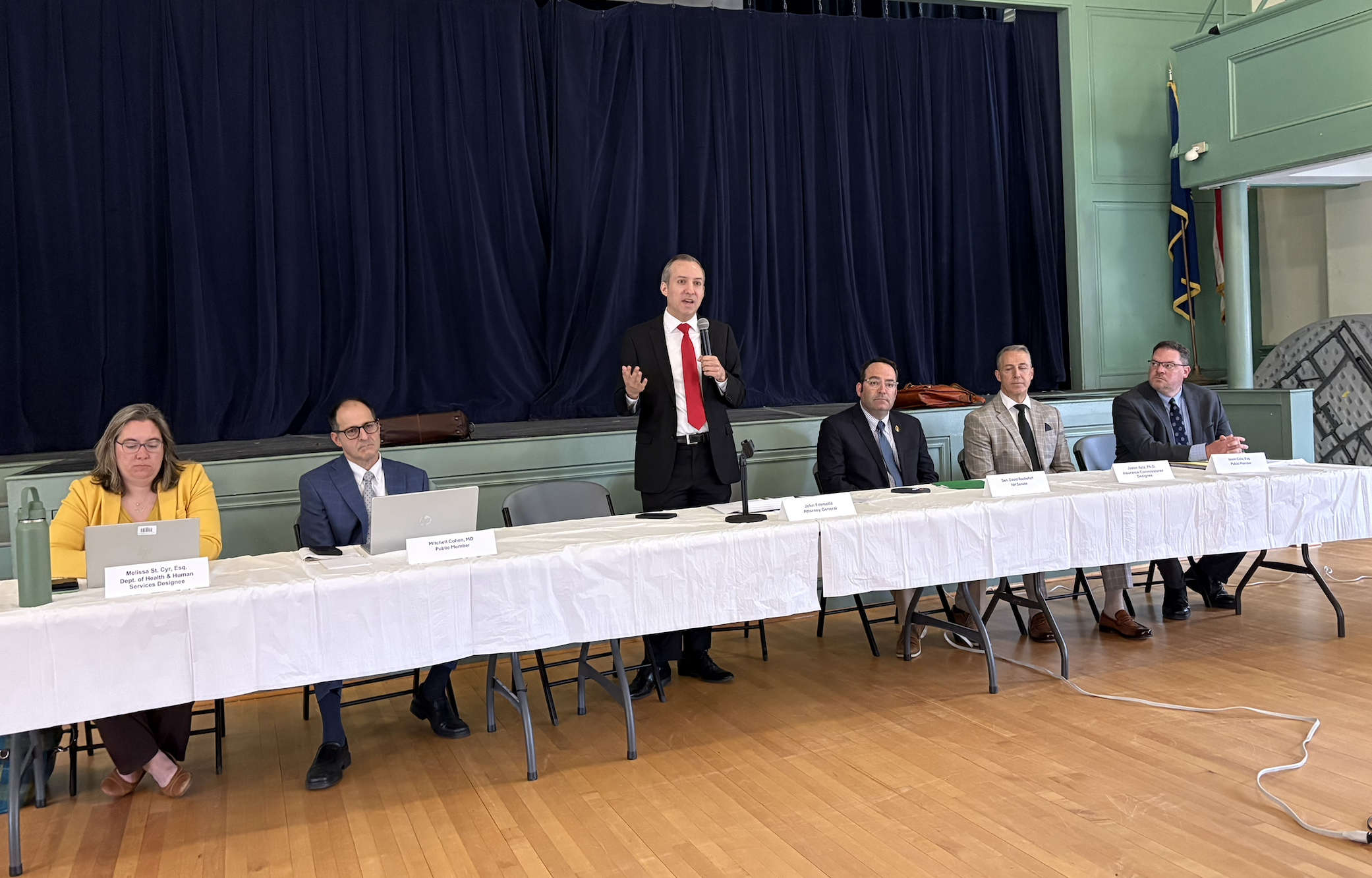
On April 29, the New Hampshire Healthcare Consumer Protection Advisory Commission (HCPAC) convened a public meeting at Exeter Town Hall. The purpose was straightforward: hear directly from the community about what has changed since Exeter Hospital became part of Beth Israel Lahey Health in 2023—and how those changes have impacted patients.
It was clear from the start that New Hampshire’s entire health care system is in a period of unrest, and that the voices of patients, providers, and community leaders can play a critical role in shaping what comes next.
The Exeter Town Hall was full—about 90 people in person, with others joining online—and the conversation that followed provided insights more complex than a simple up-or-down take on the merger. It was, instead, a window into a health care system in transition, where the benefits of consolidation and the realities of local care do not always align.
Opening the meeting, Attorney General John Formella laid out the role of the Commission and the limits of the state’s authority. When non-profit hospitals are acquired, the Attorney General’s Office reviews the transaction through two lenses: whether it serves the public interest and whether it harms competition. But those reviews happen years before the full effects of a merger are known.
“What we’re trying to do here,” Formella explained, “is not just look at the transaction itself, but create a way to respond to its impacts over time.”
That response can come, in part, through the Healthcare Consumer Protection Trust Fund—a dedicated pool of resources intended to address gaps or disruptions that emerge after a merger. The Commission’s job is to guide how that fund is used. But as the evening in Exeter made clear, funding alone cannot resolve many of the tensions that communities are experiencing.
When public comment began, the tone shifted quickly from the process to the personal.
One of the first speakers, a resident from Rye Beach, described local access that feels harder to navigate than it once did. She pointed to the closure of specialty services, specifically pediatric dentistry, and the speed at which those changes occurred. “There wasn’t time,” she said, describing the transition. “No continuity of care.” She spoke of difficulty obtaining medical records and a growing reliance on mid-level providers in place of physicians. For older patients in particular, she suggested accessibility and communication have declined and the systems have become more confusing and less personal.
Others echoed similar concerns, especially around access. Long wait times for specialty care were described as routine, not exceptional. One local physician noted that it can take nearly a year to schedule certain procedures—“absolutely unacceptable,” he said. Several speakers described leaving the region altogether for care in Boston, not out of preference but necessity.
Cost was another persistent thread. Higher copays, uncertainty around billing, and a general lack of transparency were raised repeatedly. One speaker framed the issue simply: patients are being asked to act like informed consumers in a new system that is increasingly difficult to understand.
At the same time, community members urged the Commission to look more closely at whether the commitments made during the merger are being fulfilled. Exeter resident Deb Fournier raised questions about capital investment timelines, the status of required clinical service plans, and long-term guarantees around essential services like labor and delivery.
There was frustration in the room, and repeated complaints of poor and insufficient communication with individual patients and the community.
Executive Councilor Janet Stevens encouraged more ongoing accountability as to whether the commitments tied to the merger are being met in practice. She pointed to abrupt service changes early in the transition—including the loss of several specialty services—and raised concerns about the pace and visibility of promised investments. Citing recent community reporting, she noted declines in charity care and questioned whether spending is keeping pace with earlier commitments. “These are not minor fluctuations,” she said. “They represent a trend—and they matter for the populations that rely on these services.” Stevens also emphasized the need for greater transparency, particularly around clinical plans and capital investments, arguing that oversight must be “active, responsive, and focused.”
A few speakers, mostly nonprofit leaders, described meaningful grant support from the hospital—particularly in areas like food access, prevention programs, and community health initiatives. One executive director noted that funding for local programs had increased since the acquisition, allowing organizations to expand services to vulnerable populations.
Hospital leadership acknowledged both the challenges and the criticism. Speaking on behalf of the system, Debra (Deb) Cresta, President of Exeter Hospital and Exeter Health Resources, emphasized the broader context: rising costs, workforce shortages, and increasing demand across the health care system. “Standing still is not an option,” she said, framing the merger as a step toward long-term sustainability.
She pointed to a new facility for cancer care and investments in technology, including a unified electronic medical record system and greater access to specialty care through a telehealth network. Programs like teleneurology, she noted, are already improving outcomes by connecting patients to specialists more quickly than would otherwise be possible.

At the same time, she acknowledged that the transition has not been seamless. “We could—and should—do a better job of listening,” she said. “And partnering with the community.”
That acknowledgment may have been one of the most important moments of the evening.
Because beneath the specific concerns—about access, cost, and services—was a broader issue: trust. Not just in the hospital system, but in the merger process itself. At a time of much unrest in the health care system, with increasing cost and access pressures, residents want to understand what is changing, why it is changing, and how decisions are being made. They want transparency and communication not as abstract principles, but as practical tools for navigating their own care.
What emerged over the course of the meeting was not a single narrative, but a set of competing perspectives. The merger has brought new resources, expanded capabilities, and, in some cases, stronger support for community programs. It has also coincided with service changes, access challenges, continued cost growth and a sense—shared by many—that the system under BILH has become less responsive and more complex to navigate.
The role of the Commission, and of meetings like this one, is to evaluate these impacts and look for strategies and investments that can mitigate harms; to listen, to ask hard questions, and to ensure that the benefits of consolidation do not come at the expense of the communities these hospital systems are meant to serve.
While the public discussion focused on one hospital and one merger, the need for continued accountability and engagement at the community level was clear and convincing. The underlying issues—cost, access, transparency, and trust—extend far beyond Exeter.
And as New Hampshire looks ahead, those issues are only becoming more acute for health care consumers.