
The high cost of health insurance coverage is just one of the growing pressures that must be addressed to keep patients and families healthy in the Granite State. People also need a health care system where they can find a provider, secure a timely appointment, fill a prescription and understand and pay their out-of-pocket expenses without facing economic hardship or medical debt.
These concerns were at the center of UNH’s November 10 Building Pathways to Policy workshop, sponsored by UNH Franklin Pierce School of Law and the Institute for Health Policy and Practice (IHPP).
What would a shared approach to affordable, accessible healthcare look like?
Led by Professor Lucy Hodder, a leading NH Health Cost Initiative contributor, the workshop brought together more than 50 participants representing consumer advocates, providers, insurers, hospitals, researchers, employers and government. She highlighted strategies to leverage federal resources to help the Granite State and improve transparency so we can understand the real impacts and opportunities for cost and care. Participating organizations included New Futures, the New Hampshire Fiscal Policy Institute, the New Hampshire Insurance Department, Harvard Pilgrim Health Care, Anthem, Foundation for Health Communities and NHHCI.
NHHCI Project Coordinator, Jennifer Frizzell, highlighted the Initiative’s focus on building a network of health care policy leaders and community stakeholders to advance practical solutions for lower costs and better access. The Initiative’s efforts with public education, business engagement, consumer protection and enhancing transparency and accountability helped inform the discussion.
Different perspectives from across the sector offered useful starting points for what could come next:
Start with a focus on what patients actually pay
Insurance premiums are only one part of affordability. Deductibles, prescription expenses and other out-of-pocket costs also determine whether coverage works for a household. A useful affordability measure should therefore ask more than whether someone has insurance. Can they afford to use it? Are they putting off care? Do they understand what each service will cost?
Rising medical debt and the lack of health insurance navigation are equally important consumer protection concerns. Helping someone find coverage is essential; helping them understand and use that coverage matters just as much for lowering costs.
Look beyond the insurance bill
Credit: New Hampshire Insurance Department
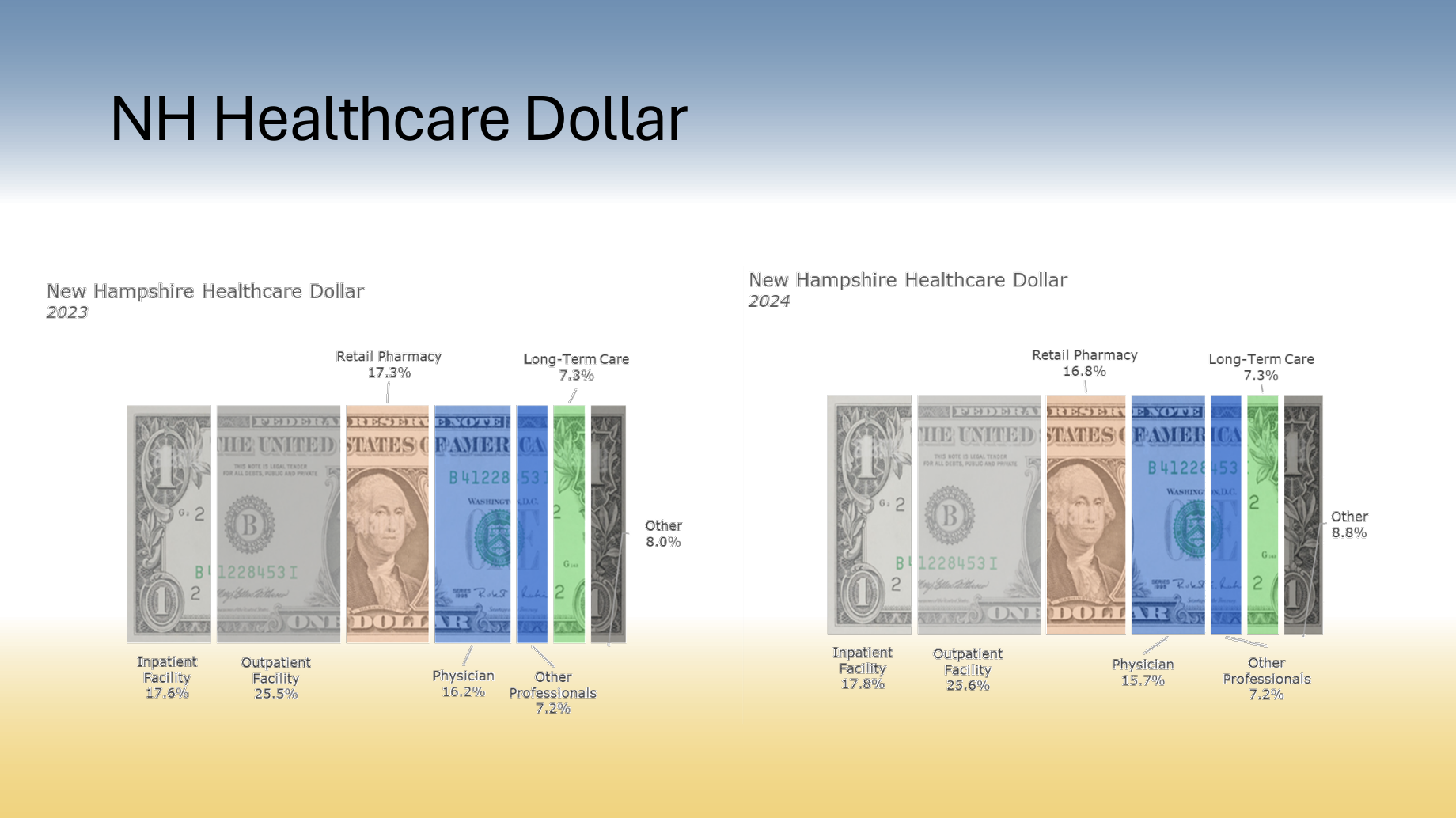
The Granite State is spending a lot on healthcare. The New Hampshire Insurance Department’s expenditure model measured $13.7 billion in health care spending in 2024, and helps shine light on a range of expenditures that policymakers and consumers are still trying to understand.
The presentation’s “NH Healthcare Dollar” breakdown for 2024 illustrated where spending goes: 25.6% to outpatient facilities, 17.8% to inpatient facilities and 16.8% to retail pharmacy. Together, those categories accounted for about 60% of the healthcare spending, and explain why affordability discussions must also examine the underlying price and use of medical services and prescriptions. The wide variety in specialty drug costs, hospital in-patient and out-patient charges and co-pays among consumers is confusing and impacting patients, employers and community providers across New Hampshire.
Make information available—and useful
Participants explored better ways to explain healthcare spending, including an affordability dashboard and benchmarks for tracking cost growth and informing consumers.
Professor Hodder’s presentation described how federal policy developments impact New Hampshire healthcare and highlighted how other states stay informed by using cost growth targets to assess how quickly healthcare spending rises, often tied to wage growth or the broader economy. Similar benchmarks could help New Hampshire measure whether health care costs are growing faster than people’s ability to pay.
The Insurance Department’s total expenditure model provides a foundation for that work. But spending totals also need context: which populations and services are included, what year the figures represent and how the measures change over time.
For consumers and employers, greater value would come from clear answers: Where is spending increasing? What is driving it? Are people getting better access and outcomes? How do policy changes affect household costs?
Clearer tracking and reporting of the state’s health care funding and expenditures could also help residents see how public dollars support services and what funding changes mean for their communities.
Ask what changes mean for local communities
Communities have watched while healthcare consolidation and corporate ownership shifts change how and where care is delivered. There has been very little oversight in this area and consumer interests and community well-being have suffered. Stronger consumer protection measures are needed to help NH communities better understand the shifting healthcare landscape and provide tools that give consumers meaningful influence over health care decisions.
For example, the rapid growth in Free-Standing Emergency Rooms is driving higher costs and generating confusion with urgent care centers among patients. As new facilities enter a community, residents deserve clear explanations of the services offered, how billing works and how the expansion may enhance or undermine existing providers. The same questions apply when hospitals merge: What will change for patient experience? What will it cost? Who will pay? Who will monitor the results?
NHHCI’s community conversations help bring these questions forward. They provide a place for residents and local partners to identify concerns that may otherwise be lost in technical discussions.
Connect the efforts currently underway
Credit: UNH Institute for Health Policy and Practice
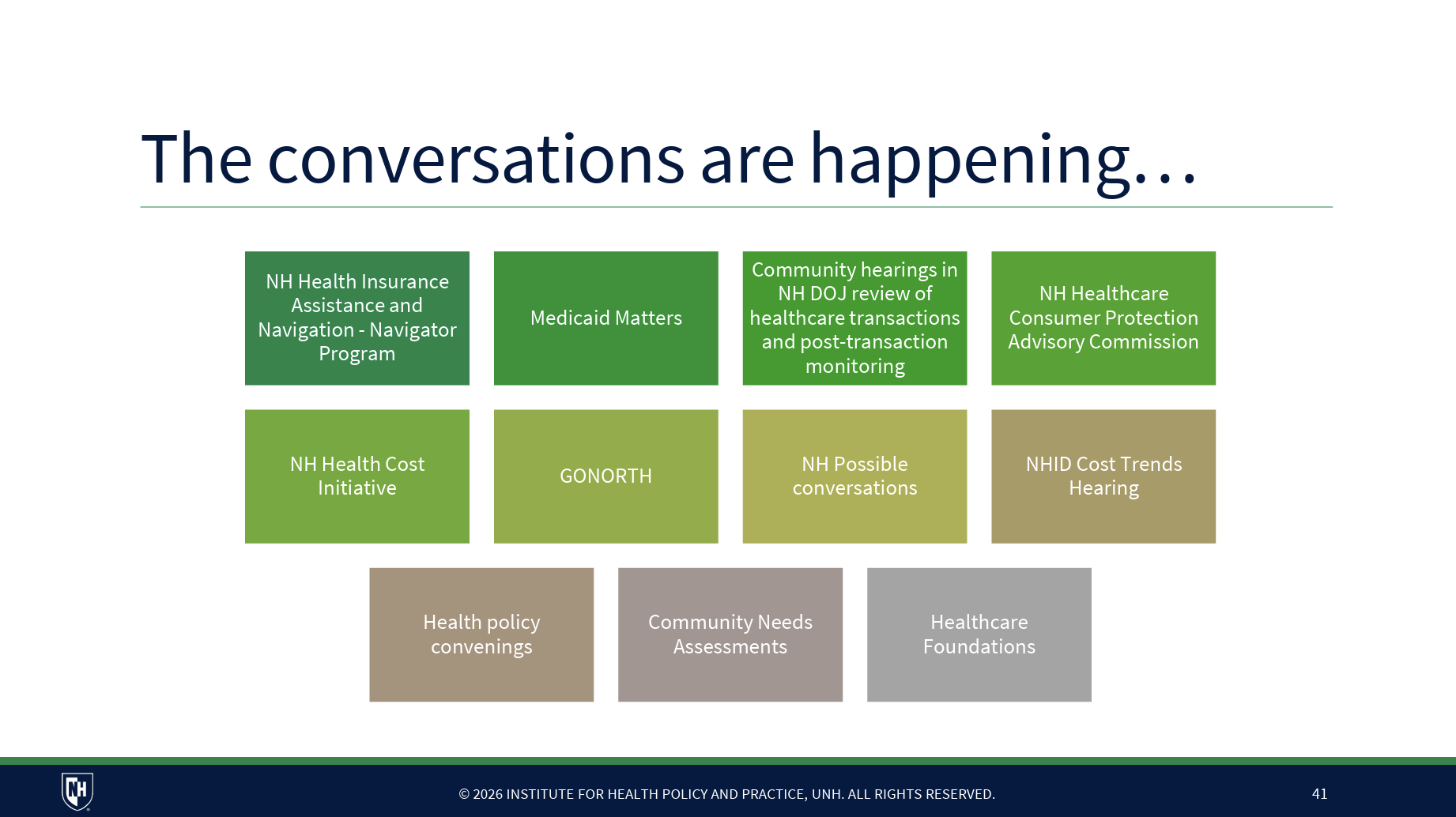
New Hampshire has many organizations looking at health costs, medical debt, insurance coverage, prescription drugs, consumer protection, public spending and access. Existing efforts to track costs and improve accountability range from insurance navigation and community health needs assessments to the Insurance Department’s cost trends hearings and the AG’s reviews of hospital transactions.
A more coordinated approach would help New Hampshire develop a state plan, establish shared goals, make responsibilities clear among stakeholders and give communities a stronger voice and a better way to follow progress. Several participants felt that the legislature needs to take a more active role in shaping policy and urged that a plan for health care affordability should be developed by a “Blue-Ribbon” commission or other multi-stakeholder entity that is adequately resourced and bipartisan.
The workshop discussions also outlined a potential increased role for the Health Care Consumer Protection Advisory Commission, which advises the state’s Department of Justice and attorney general on the use of the Health Care Consumer Protection Trust Fund. Several participants emphasized the need to enhance advocacy and expectations for this Commission (HCPAC).
NHHCI has been closely engaged with this commission’s work. More public input, more oversight of post-merger conduct and greater transparency about costs and access after consolidation were all areas identified for the HCPAC to better serve consumers.
NHHCI will continue to catalyze the conversation
For NHHCI, UNH IHPP’s workshop reinforced the value of bringing information and people together: explaining cost drivers, examining local trends, listening to communities and asking how decisions affect access and affordability.
We see three useful priorities emerging from the discussion:
Define progress and policy solutions in terms people recognize: affordable prescriptions, understandable bills and care they can access.
Connect information with accountability: establish clear measures, explain the data and enhance oversight.
Keep communities involved: give residents meaningful opportunities to shape priorities and assess results.
The measure of progress will be whether Granite Staters can get the care they need at a cost they can manage.
Learn more at nhhealthcostinitiative.org.